Personal

Top Trumps
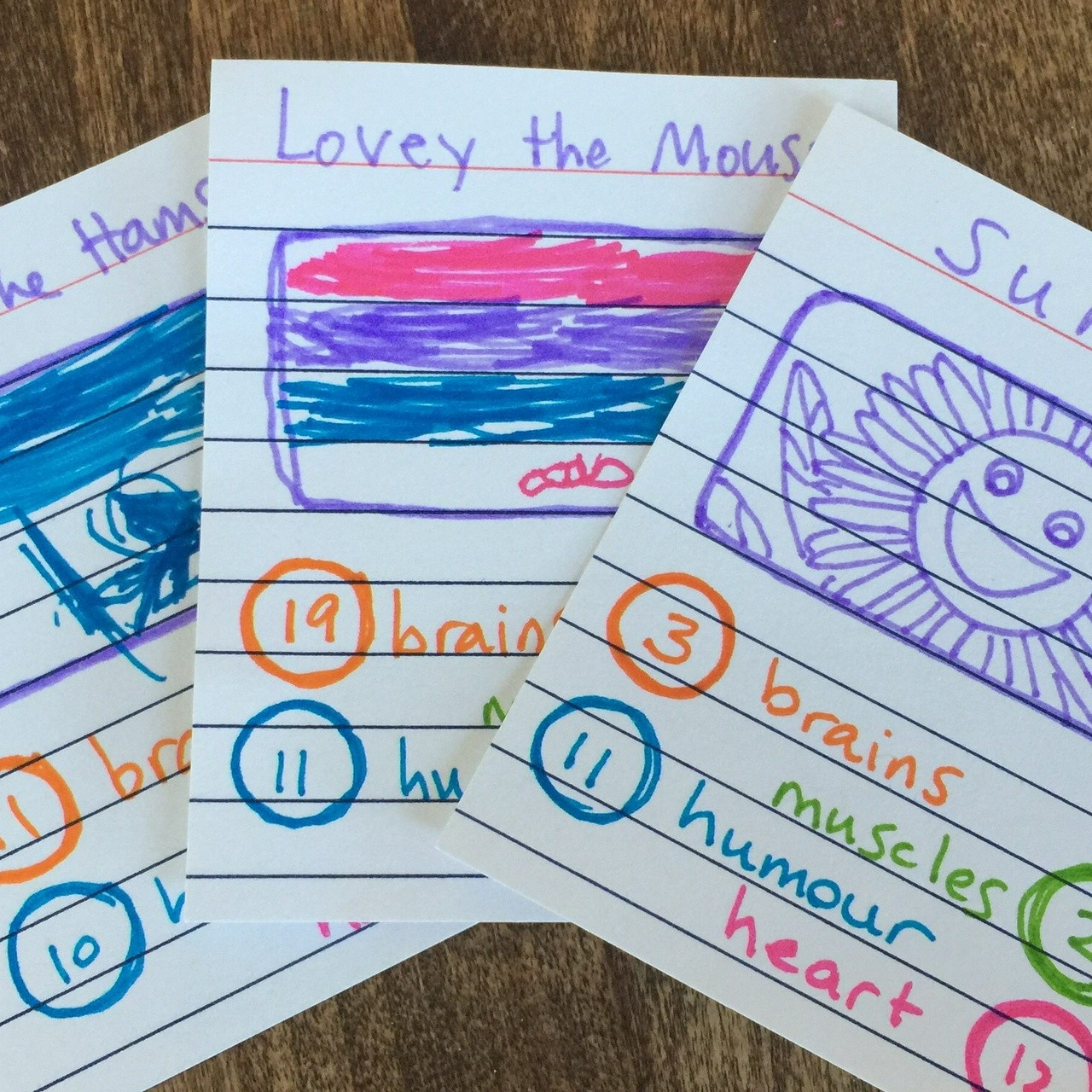
Making Top Trumps with the kiddos.
#Original Games #Games #Personal
This whole 2016 election cycle was craziness. But one thing that kept popping up in my mind was the classic kid's card game Top Trumps. It's a game I have distinct memories of playing as a kid in the UK.
Gameplay is pretty simple: each card represents a thing (car, superhero, etc), that have a selection of numerical attributes (speed 32, handling 14, torque 22, etc). Each player's cards are stacked so only one can be seen. On their turn, a player picks one of those attributes, and the player who's top card has the highest value in that attribute collects the trick. The player with all the cards at the end wins. It's a great game for young kids, as it has some math, some social interaction, and up until the end is pretty balanced. It also has the cards in a stack instead of a fan, so young hands can manage.
The thing that interests me about the design of this game is the selection of attributes, as these attributes intrinsically carry value. Then each character embodies these values based upon their numbers, so the characters themselves carry value. So there are two points of value judgement: in describing a character, and in associating with a given character. This leads to the “top trump” card — the most powerful card in the deck. So, for example, a version that chooses for its gameplay attributes “power, speed, looks, volume” carries a different set of values than a game that chooses “heart, empathy, diplomacy, cooperation.” Secondly, a card that scores highly in those attributes will carry more gameplay weight, and therefore carry more value.
Especially for a kids' game, this feeds into a child's collection instinct and reinforces those external values. Naturally, there will be players who do not associate the numerical values with judgement values, and play the game in the abstract; but I feel that they are in the minority amongst children.
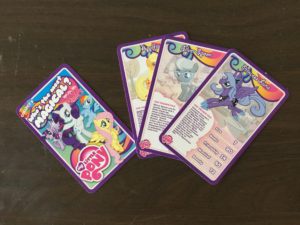
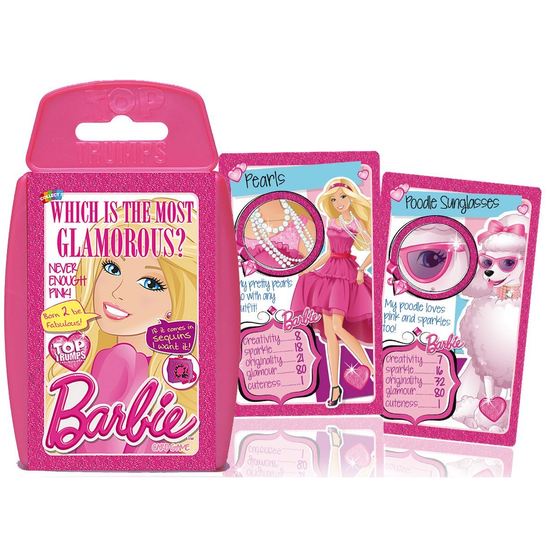
The gameplay lends itself very well to theme skinning, as can be seen from the multitude of versions out there. Currently there are a lot of versions targeting boys — Transformers, superheroes, etc. — which isn't surprising. But there were also some targeting girls — My Little Pony, Barbie, etc. Being personally invested in games for girls, I checked some of them out. Naturally the Barbie one was fairly insipid (“Which is the most glamorous? Never enough pink! Born 2 be fabulous! If it comes in sequins I want it!”). The My Little Pony one was alright (gameplay attributes: “size, magic, friendship, mischief, beauty”).
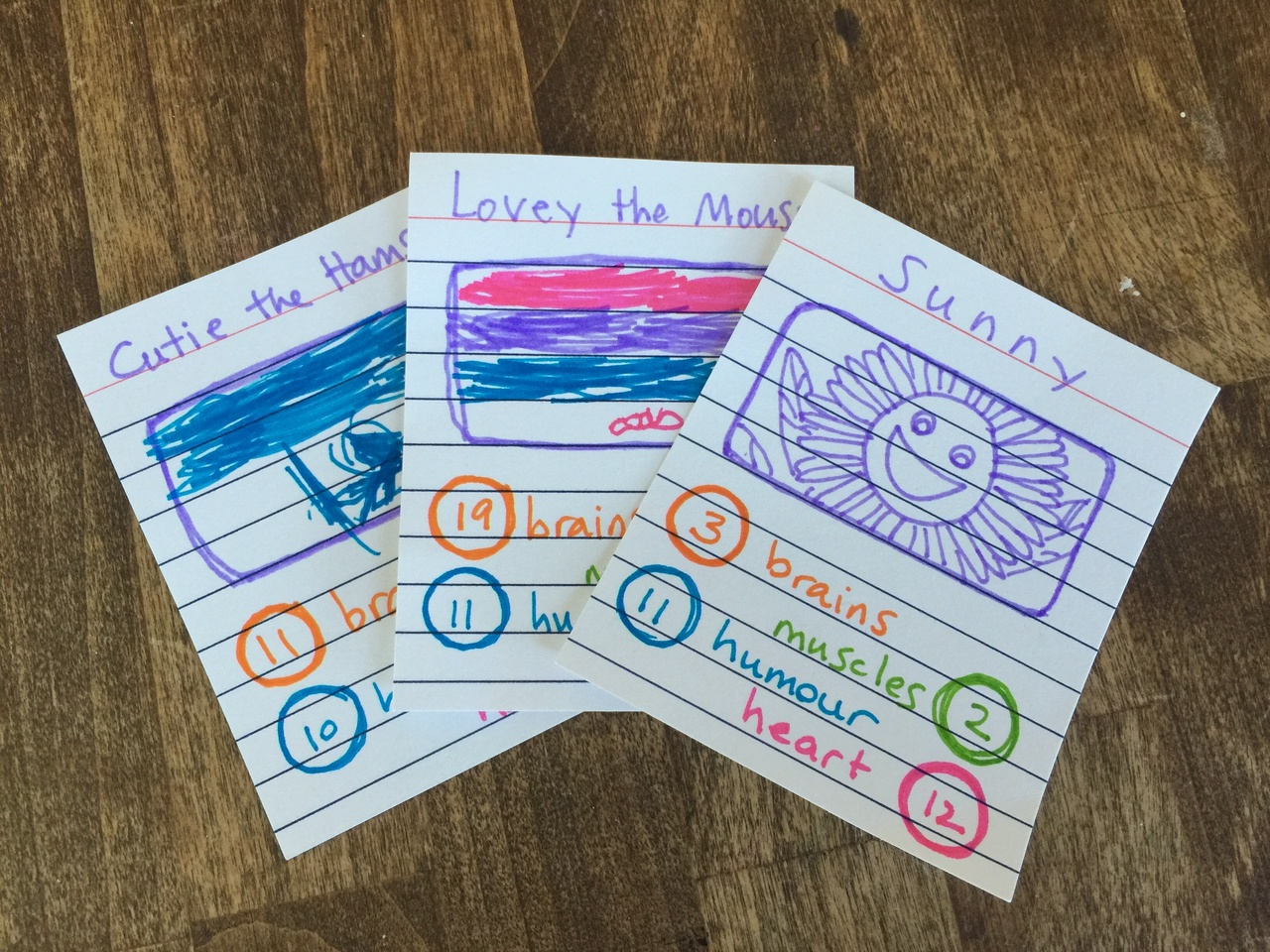
So I set out to make a deck with my own kiddos. We sat down and figured out the values we wanted to attribute, designed a template (colours work great for those kiddos who can't read yet), and set out making cards. I wanted it to be directed by W and Q as much as possible, so I set no guidelines about who the characters should be.
The girls decided on brains, muscles, humour, and heart. From there they drew the characters, and if needed gave them names. It was interesting to see Q start with established characters: Doc McStuffins, etc; and W went with real people: Mom, Nani. But pretty soon they both started making characters up. The next step was to get them to give each character numbers for the attributes. This was initially a challenge, as they both wanted to max out each character. We worked on comparisons — is “Dog” funnier than “Poppy the Pillbug”? This worked, but it was a bit odd with the real-person cards. With W's “Mom” card — which is clearly the “top trump” — W asked if she needed to stick to the 1-20 range for “heart”, or if she could go higher, “like a million or something”. It was very, very sweet.
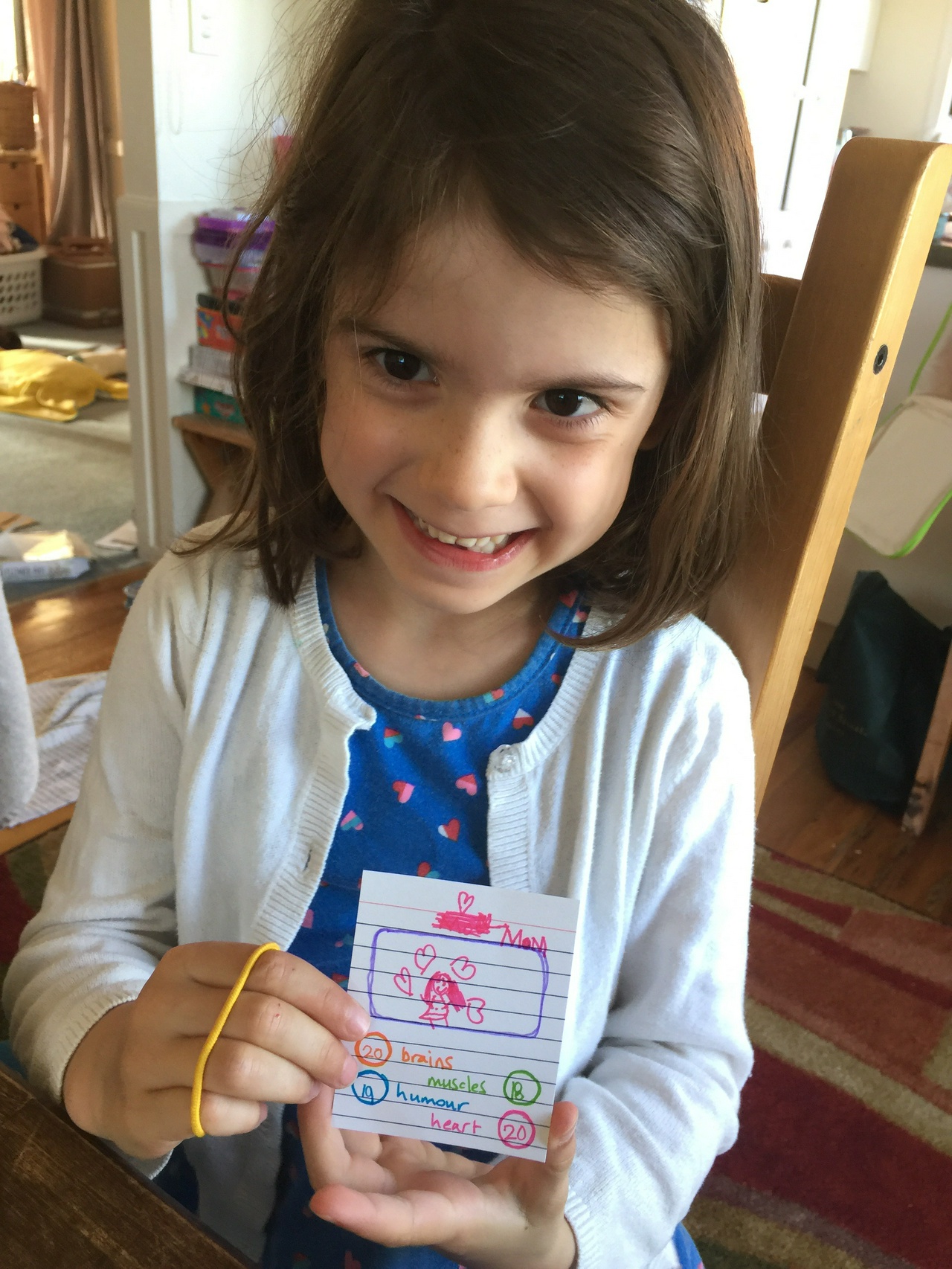
W with the “Mom” top trump card
The Tortoise and the Hare
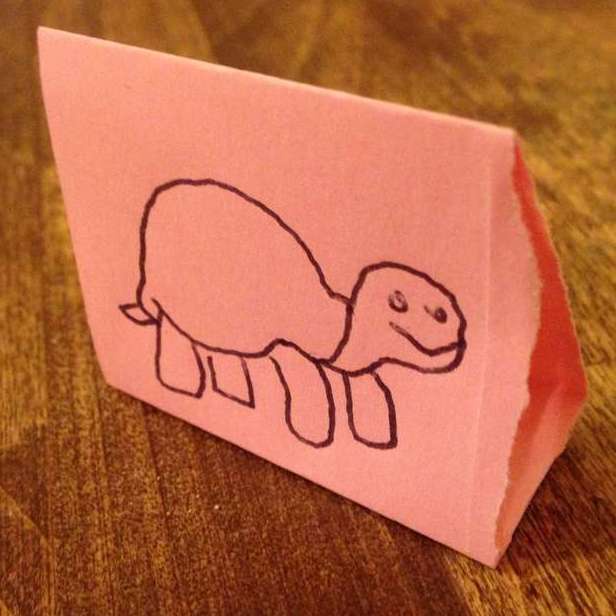
Making games with the kiddos
#Original Games #Games #Personal
As part of her weekly homework, my daughter brings home a board game from school. She's 5 years old, “Year 1” in NZ parlance. The games tend to be designed along whatever lines they're teaching at school — usually simple math — and themed almost at random (“this game is about fish! Help the fish count and get him to score the winning try!“). We all get together and play them in good sport, although I do try to resist the urge to explain Markov Chains to her. That can wait.
But it did get me wanting to design a game with my two daughters. So I pitched that we spend an afternoon or two doing exactly that, and they were game for it. Days before I had told them the story of the Tortoise and the Hare, and it seemed a good starting point: the race provided a linear A to B structure that would fit in with their other homework boardgame designs. So we chatted about how the tortoise moved, and how the hare moved. They liked rolling dice, so it seemed fitting to do that. I first showed them different types of dice, and how a d4 has a different movement than a d12. We tried a couple of tests with these, but it just meant the hare pretty much always won. Next I showed them some blank dice, and we decided to use those. Because you can draw on them.
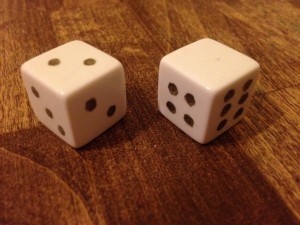
We chatted about different die pip values and frequency, and how you can change the movement of a die. We went to AnyDice and saw some charts, which they enjoyed a lot more than I was expecting.

We ended up with a pretty good balance of numbers. The one thing was the blank sides for the Hare. We wanted to have the Hare stop along the way, and had tried using “must stop” locations on the board, but that seemed to have a predictability that wasn't desireable. The blank die sides are effectively a “miss a turn” roll, which is often bad game design, but it matched the metaphor so well we kept them. We did have to do more balancing later, but more on that later. The next step was the board. James Ernest has a great essay on volatility, including a section on the game “Kill the Elf”. In this game, the number of spaces in the race is effectively the hit points of the elf, and the tortoise the warrior and the hare the wizard. Too few spaces in the race, and the hare wins more frequently. Too many, and the tortoise has the advantage.
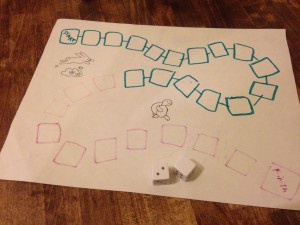 |
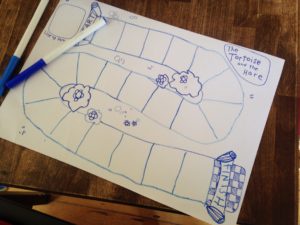 |
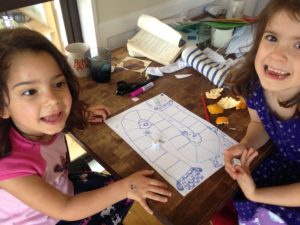 |
| Board version 1 | Board version 2 | Playtesting |
The girls were up for several rounds of playtesting. They definitely preferred to play the tortoise, but the hare won just as many games.
The game made it to school. The homeroom teacher took a look, and sent it back home with a note that there were “too many blank sides” to the hare die. It's always good to get external testing.
Studio visit with Bean Gilsdorf
#Artwork #Personal
I just had a lovely studio visit from Bean Gilsdorf. The process of a studio visit is fascinating — two people, who probably have never met each other, get together and talk. Things like that should happen with more frequency. And happen across disciplines.
We only had half an hour to chat, so we didn't get too in-depth, but I was excited to hear her thoughts about how to get the most out of grad school, ideas on submitting proposals for writing, and about the importance of just getting out there and talking with people. It's given me more impetus to get deeper into the Portland art scene, and see what's going on around here.
I would strongly recommend anyone take a look at Bean's work, and especially to check out her column Help Desk with the Daily Serving.
Whence to pirate?
#Personal
Recently I've been thinking about the benefits of being a pirate. I play bass in a little pirate band for kids, and we've been at it for almost ten years. Ten years. We have four albums to our name, and we draw decent numbers for our shows here in Portland. We pour our little pirate hearts into each show, even the ones that are... challenging, and I think everybody has a grand time. Every now and then we get emailed adorable photos of kids rocking out at home, or pictures they drew of us, and it bouys our hearts beyond compare. But on the whole, this enterprise is not a money-making machine. We're generally in manageable debt, and the money we make does help with the bills. But it's pretty nominal, and we all have other full-time jobs. With five of us in the band, with families and loved ones, it gets difficult to schedule and get on the same page. We get told a lot that we must have a lot of fun — and we definitely do — but there is a lot of overhead that weighs heavily. The crew are such wonderful people, it's hard to imagine they need to do any other work; but the reality these days... I don't know.
Sweet and Sour
Creating the music video for Pieces of 8ight.
#Music #Personal
So yesterday the band and I had a great opportunity to shoot a music video with a local film production company. The director donated his time, a local company donated a bunch of beautiful 16mm film, and about 15 local crew worked for dirt for over twelve hours. We even had the thing catered, by the Russell Street BBQ. There were interns! Everyone was very professional and laid back at the same time, which was very cool. We had a bunch of kids show up to be our audience, and to be in little gags during the video.
Its off for processing and editing, and hopefully will be in our grubby little hands in about three weeks.
The sucky thing was on the way home, while we were stopped for a celebratory beer. Someone broke my rear window of my car and stole my bass amplifier, the same one I've been using for every single pirate show. There were people around who saw it “go down”, and were a great help with the report to the police. I'm spending this morning trying to track down the serial number to stop it going to pawn shops, but I'm skeptical I'll ever get it back.
It was a great amp, and its going to be missed. Things could have been worse. The bass I made myself was in the trunk, along with more equipment. The rest of the band's gear was in a van right in front of my car, and if it were dark or more secluded, they could have easily broken into that as well.
And hell, we'll have a fantastic-looking music video soon.