Lucas Haley

Games

Arkham Horror

In which we actually get a game going
#Games

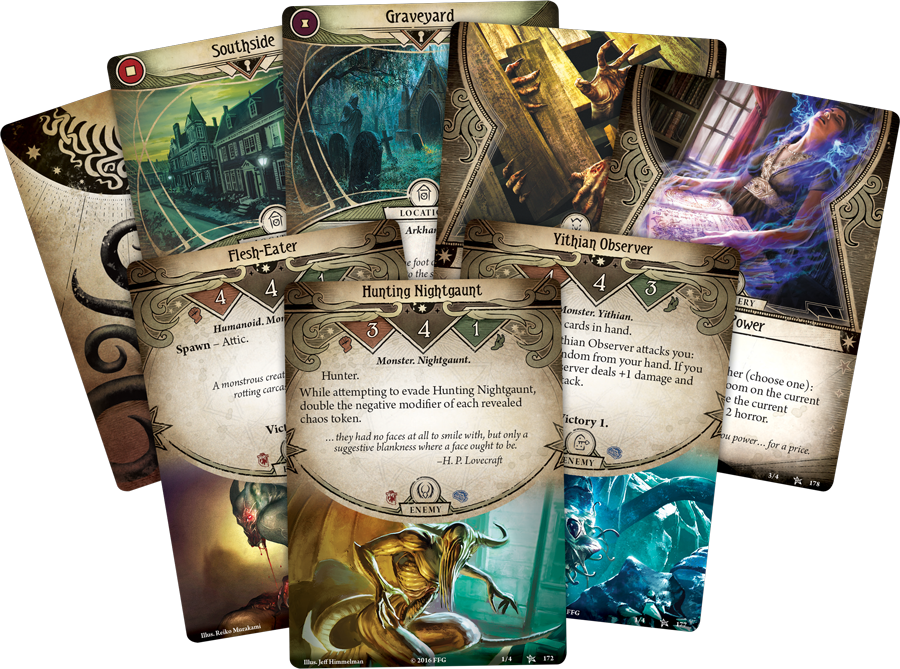
I've owned a copy of Arkham Horror: The Card Game for seemingly over a decade, without it ever getting to the table. It's been difficult finding both the time and the right people. Until now.

Read more...

Vive la france!
#Game Design #Games

This post on Snit's Revenge made me ponder about asymmetry in games – both in terms of design and context. For design, I thought it might be cool to create an ongoing list of ways in which a game may be asymmteric:

  • player goal
  • player movement
  • player behaviour
  • board layout
  • etc etc

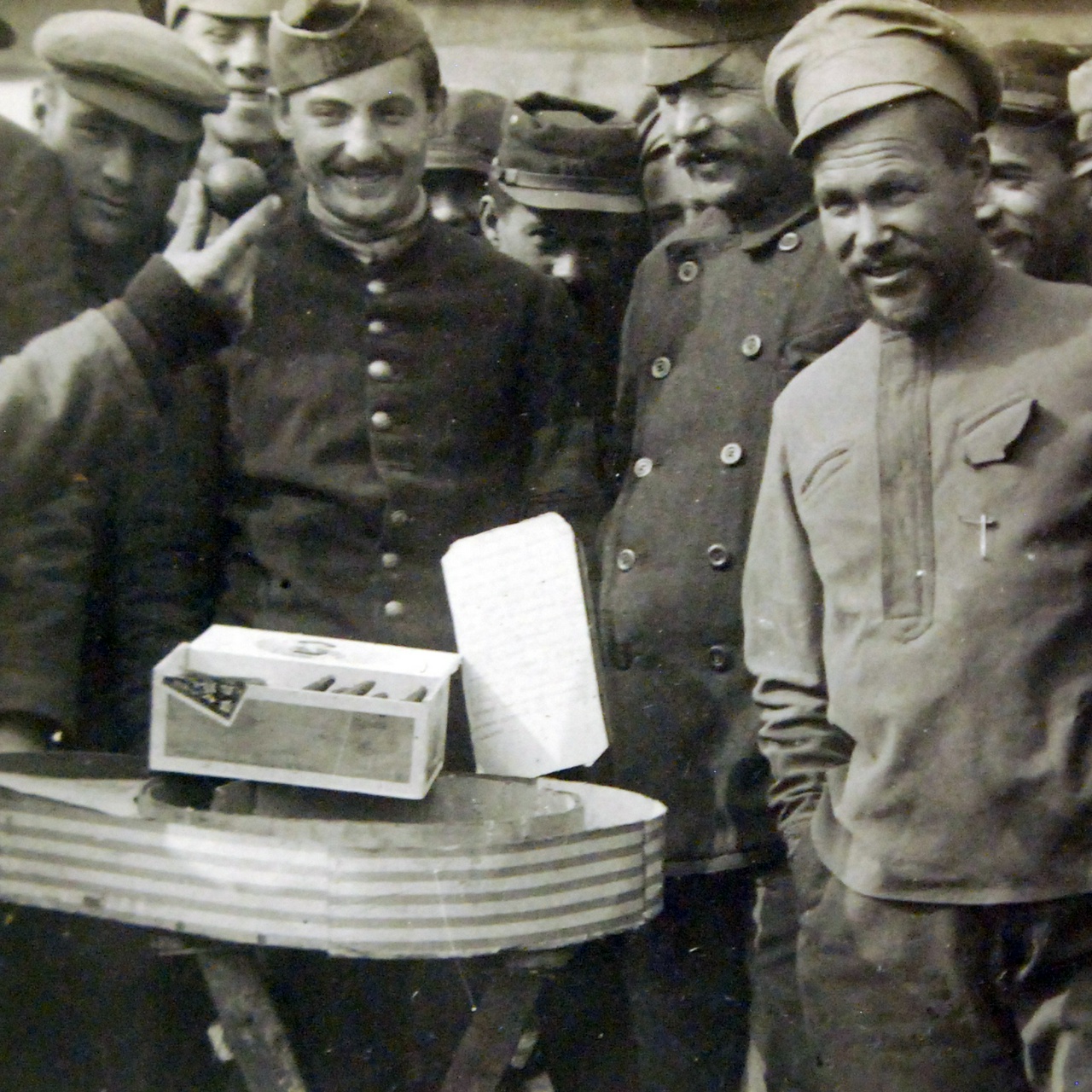
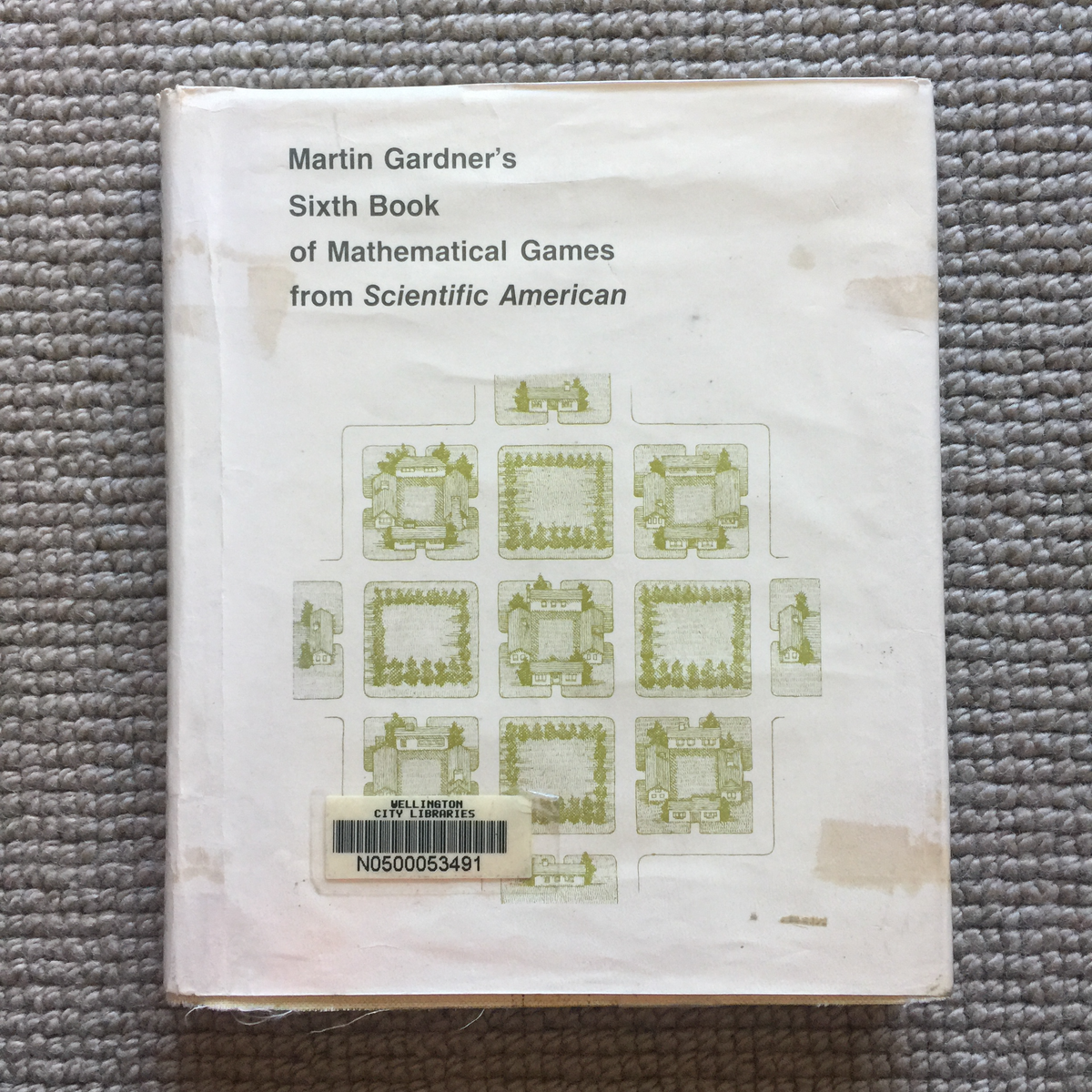
It's another list in my array of Field Notes books. I'll type it up when it's more robust. I was also reminded of the French Military Game. Which is a terrible title for a game, but there we are. It was a game popular with the French Military in the 19th century, more recently written about my the amazing Martin Gardner in Martin Gardner's Sixth Book of Mathematical Games from Scientific American.

The FMG is asymmetric with number of player pieces, player movement, and player goal[^1]: The three white pieces can move sideways, forward, or diagonally forward; the single black piece can move in any direction. The white pieces want to trap the black so that it cannot move, and the black piece wants to get past the white (which cannot move backward).

The FMG sits in the set of “Hunt Games”, where one player is hunting the other. By their nature, hunt games are asymmetric in at least one way. Other traditional hunt games include:

  • Bagh Chal and Bagh Guti, from Nepal
  • De Cercar La Liebre, from Spain
  • Fox & Geese, from Britain

I'm still on the fence as to whether I would consider hnefatafl a hunt game. But that's just semantics – it's still asymmetric in player movement and number of player pieces. But hnefatafl deserves a whole post unto itself really.

[^1] not so sure about asymmetric goal in this game. It's more of a mirrored goal.

Thoughts on sheepherding
#Original Games #Games #Sheep

I am currently working at Massey University in New Zealand. The university has three campuses — Auckland, Manawatū, and Wellington. Wellington has the College of Creative Arts, which is where I'm working.

The Manawatū campus is the premiere veterinary university in New Zealand. A lot of Massey's identity comes from it's agri — vet, food science, farm engineering, etc. And while CoCA is the oldest (and arguably best, not only because I'm there) art school in NZ, there is still a patina of agri across all of Massey.

So I'm learning about sheep dog herding.

It's very fascinating.

Bear with me here. I read a random scientific article a couple of weeks ago about sheep and sheep dog behaviour, and how using drones some scientists have started to research how the whole thing works. And while the article didn't get very far, it did introduce to me the basic sheep dog commands: come by, away, lie down, walk on, etc. And the seed was planted.

By the way, one of the best websites I've found for sheep dog stuff is this one.

Here's the thing that interests me: with sheep dog herding, you basically have a bunch of autonomous agents (the sheep), with their own behaviour. There is also a single autonomous agent (the dog), that has it's own behaviour – but will respond to the owner's verbal and whistled commands. If the dog is trained well enough. The natural progression is to make this into a game.

I've made some headway – the sheep behaviour is pretty rudimentary right now, but workable. They wander looking for food, and get nervous and scared based upon the presence of the dog.

The dog's behaviour is a little trickier, but I've made some progress there too. It successfully corrals the sheep.

Most recently I've added the IBM Watson speech-to-text functionality, allowing the player to use voice commands. I'm in the process of iterating the dog's behaviour to react.

After that, it'll be refining the behaviours to allow for sheep and dog personalities, and lastly making a VR version. Just because.

{% include youtube.html id=“mquZPv50nd0” %}

A divination deck.
#Games

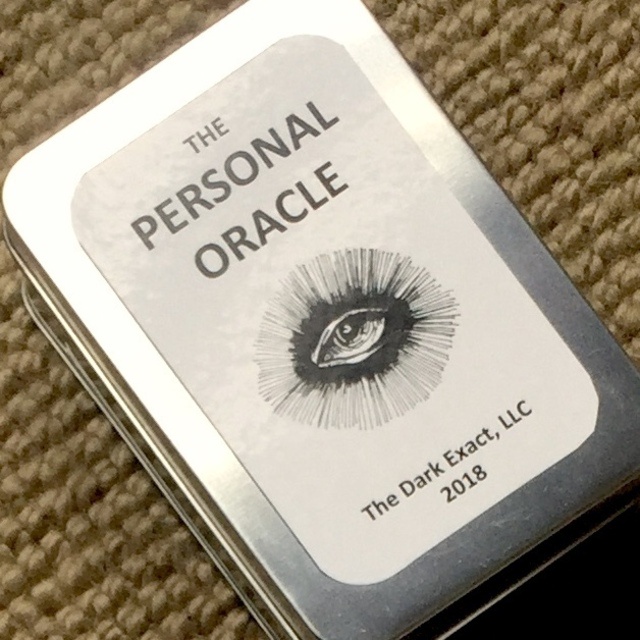
The Dark Exact, otherwise known as Coleman Stevenson, is a one-person divination powerhouse from Portland, Oregon. Her work spans original tarot decks, ritual kits, and divination guides; all with a striking black and white minimalist aesthetic.

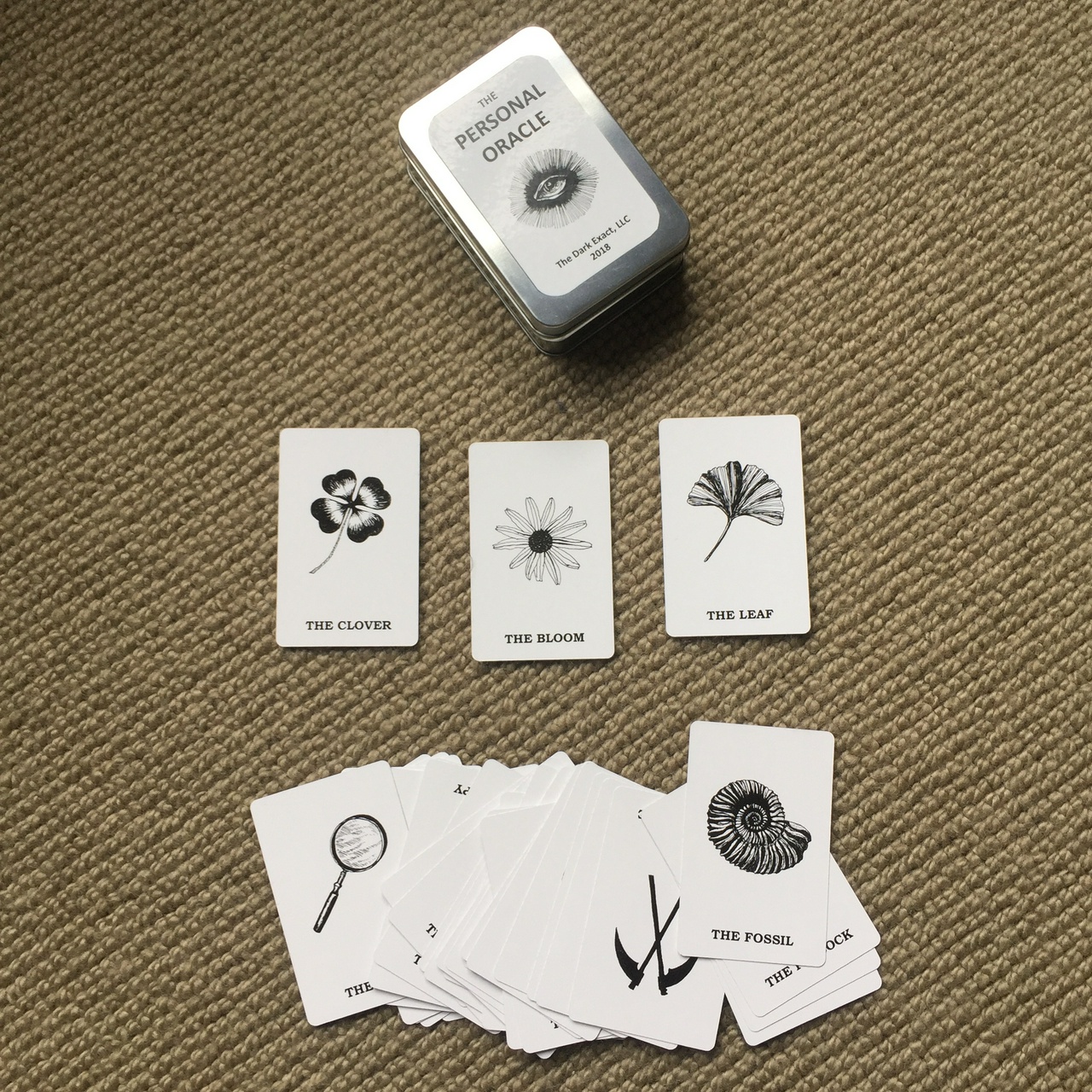
Her latest work is a compelling evolution – The Personal Oracle. Breaking from the traditions of tarot, this deck is near-blank slate for users to investigate and develop. Presented are 39 cards, each with an image and title; the symbols are varied, ranging from “The Boot” to “The Sun”, with a fine selection in between. The symbols are untraditional but non-arbitrary, selected with unspoken intention – they are open potential. Unlike the tradition tarot with its fixed symbolism and centuries of interpretation, this deck is meant to be interpreted anew by each owner. The accompanying book is mostly blank, so that each owner can fill in their own guide as they use the deck.

My first reading

It's a very clever idea, and one with a lot of merit. I've always loved the traditional tarot, but have often struggled with the internal symbolism at work. This deck makes no bones about being a pre-picked selection of symbols – each having a meaning for the original author – but are generic and non-judgemental enough for any owner to take them in their own directions. The thing I admire most about the deck is that it acknowledges that “fortune telling” is not about magically telling the future, but about a process of investigating one's own intuition through symbols – and in this case, the deck abandons the traditional tarot for a tabla rosa, allowing for that investigation to happen without historical baggage. I'm excited to explore this deck, and begin to develop my own symbolism. Some initial thoughts:

  • the artwork is clean and crisp. Beautiful stuff

  • the deck is small – smaller than tarot or poker decks – but I find that a nice portable size

  • the deck is pretty lightweight – for an object that is meant to grow with the owner, the cardstock is thin

  • This requires a lot of work from the owner, as you need to create meaning and interpretation from scratch. But that's its strength too

  • I've been struggling with there being 39 cards. I feel like that number should have meaning, but haven't gleaned it yet. WHY 39

  • I really, really want to make a game out of this deck

The Personal Oracle from Etsy

Making Top Trumps with the kiddos.
#Original Games #Games #Personal

This whole 2016 election cycle was craziness. But one thing that kept popping up in my mind was the classic kid's card game Top Trumps. It's a game I have distinct memories of playing as a kid in the UK.

Gameplay is pretty simple: each card represents a thing (car, superhero, etc), that have a selection of numerical attributes (speed 32, handling 14, torque 22, etc). Each player's cards are stacked so only one can be seen. On their turn, a player picks one of those attributes, and the player who's top card has the highest value in that attribute collects the trick. The player with all the cards at the end wins. It's a great game for young kids, as it has some math, some social interaction, and up until the end is pretty balanced. It also has the cards in a stack instead of a fan, so young hands can manage.

The thing that interests me about the design of this game is the selection of attributes, as these attributes intrinsically carry value. Then each character embodies these values based upon their numbers, so the characters themselves carry value. So there are two points of value judgement: in describing a character, and in associating with a given character. This leads to the “top trump” card — the most powerful card in the deck. So, for example, a version that chooses for its gameplay attributes “power, speed, looks, volume” carries a different set of values than a game that chooses “heart, empathy, diplomacy, cooperation.” Secondly, a card that scores highly in those attributes will carry more gameplay weight, and therefore carry more value.

Especially for a kids' game, this feeds into a child's collection instinct and reinforces those external values. Naturally, there will be players who do not associate the numerical values with judgement values, and play the game in the abstract; but I feel that they are in the minority amongst children.

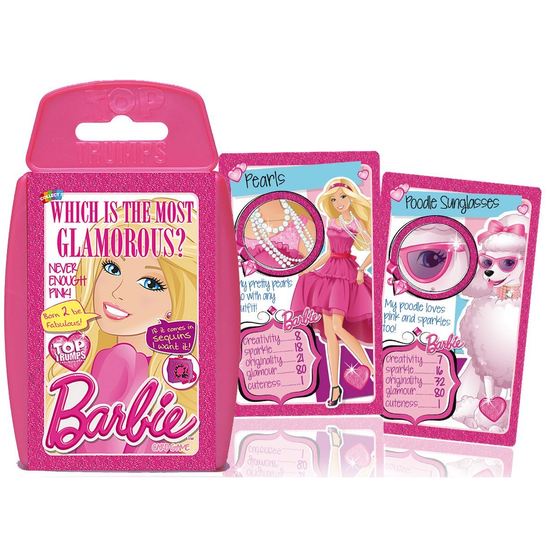
The gameplay lends itself very well to theme skinning, as can be seen from the multitude of versions out there. Currently there are a lot of versions targeting boys — Transformers, superheroes, etc. — which isn't surprising. But there were also some targeting girls — My Little Pony, Barbie, etc. Being personally invested in games for girls, I checked some of them out. Naturally the Barbie one was fairly insipid (“Which is the most glamorous? Never enough pink! Born 2 be fabulous! If it comes in sequins I want it!”). The My Little Pony one was alright (gameplay attributes: “size, magic, friendship, mischief, beauty”).
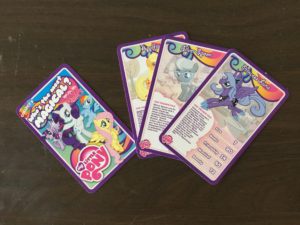
So I set out to make a deck with my own kiddos. We sat down and figured out the values we wanted to attribute, designed a template (colours work great for those kiddos who can't read yet), and set out making cards. I wanted it to be directed by W and Q as much as possible, so I set no guidelines about who the characters should be.

The girls decided on brains, muscles, humour, and heart. From there they drew the characters, and if needed gave them names. It was interesting to see Q start with established characters: Doc McStuffins, etc; and W went with real people: Mom, Nani. But pretty soon they both started making characters up. The next step was to get them to give each character numbers for the attributes. This was initially a challenge, as they both wanted to max out each character. We worked on comparisons — is “Dog” funnier than “Poppy the Pillbug”? This worked, but it was a bit odd with the real-person cards. With W's “Mom” card — which is clearly the “top trump” — W asked if she needed to stick to the 1-20 range for “heart”, or if she could go higher, “like a million or something”. It was very, very sweet.
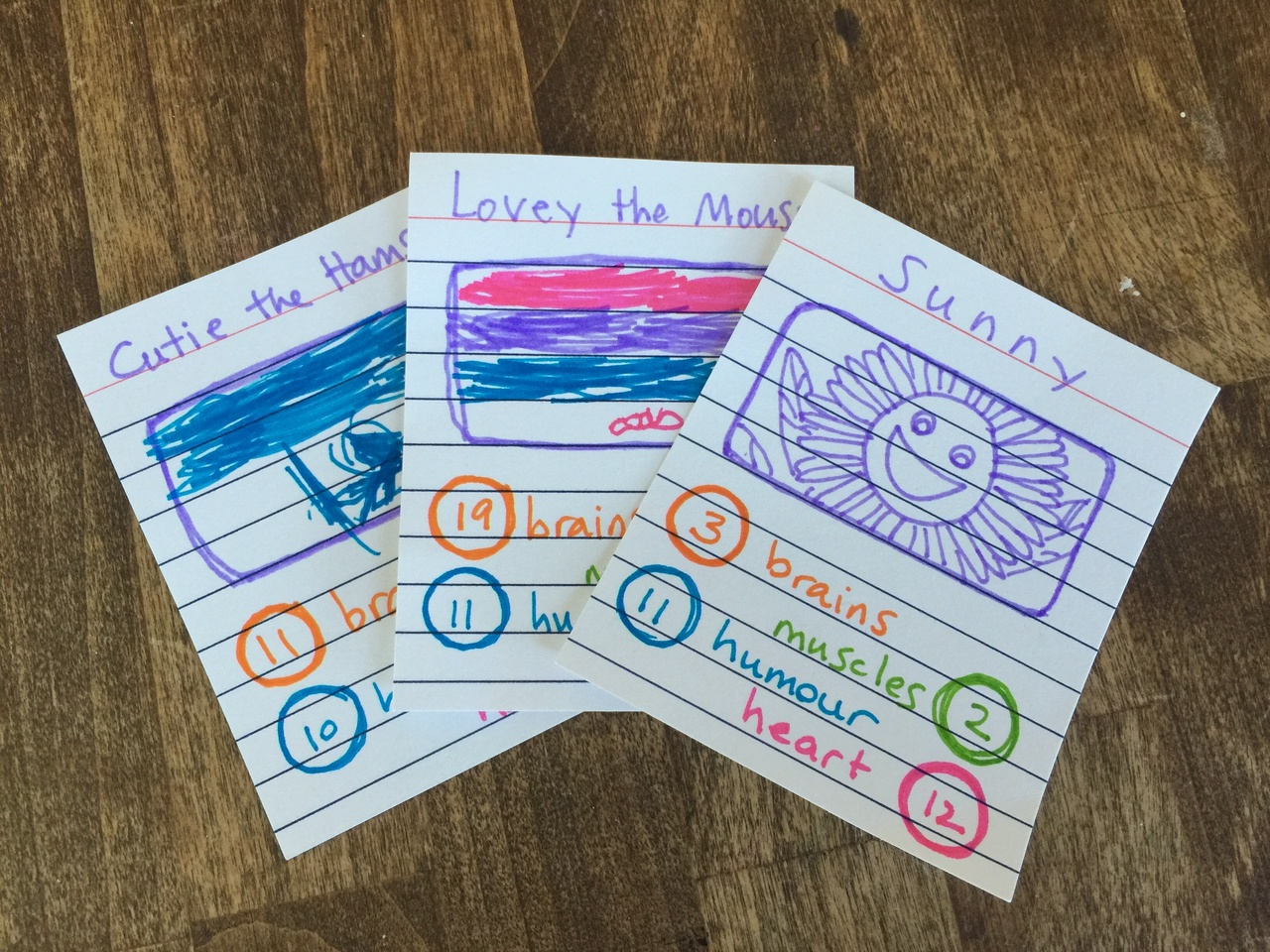
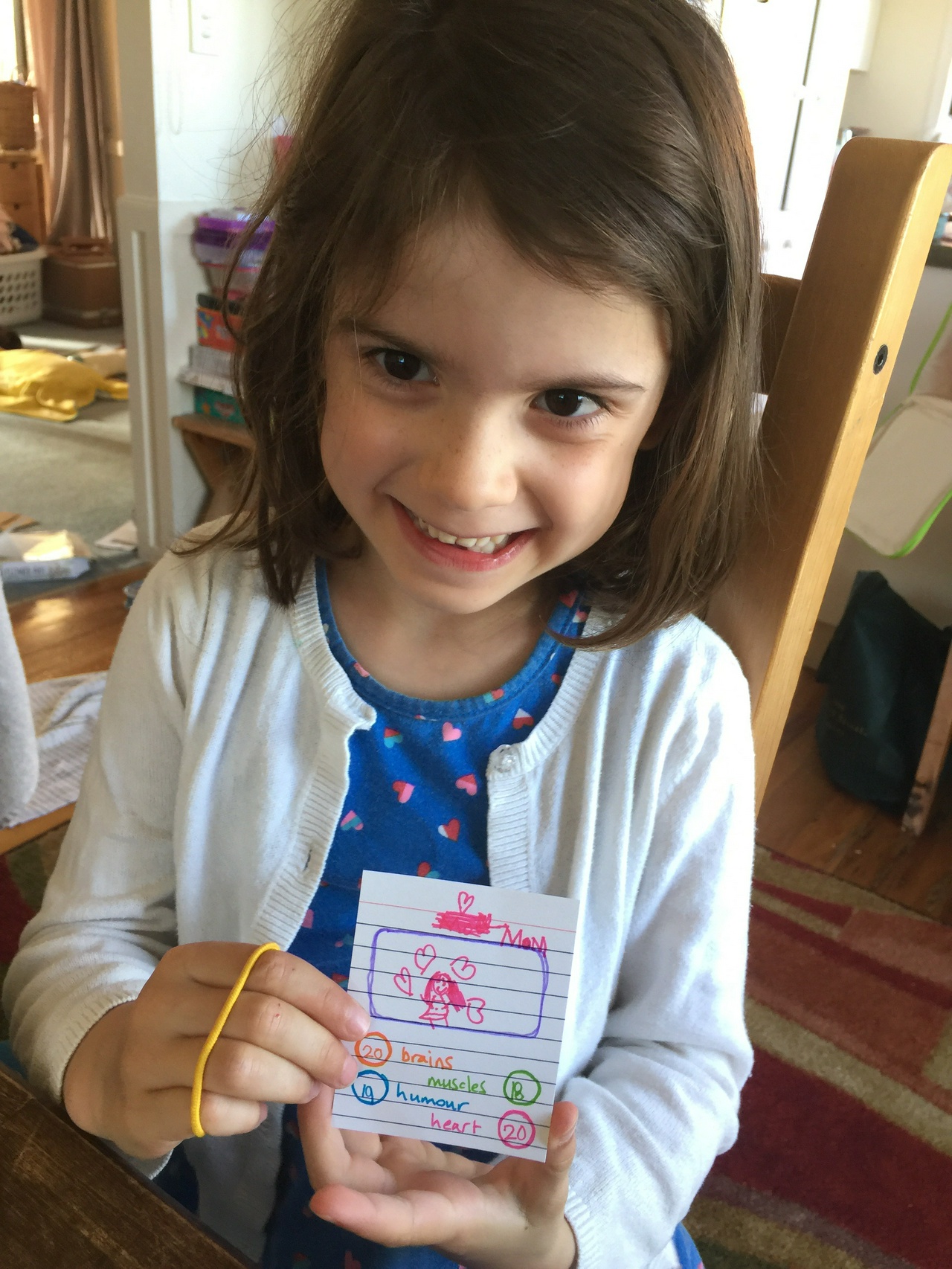
W with the “Mom” top trump card
Making games with the kiddos
#Original Games #Games #Personal

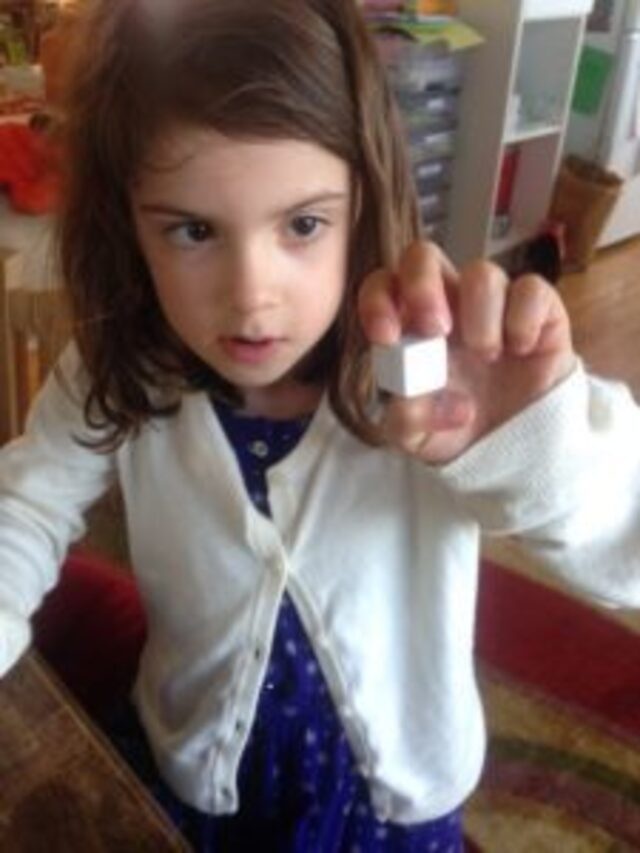
As part of her weekly homework, my daughter brings home a board game from school. She's 5 years old, “Year 1” in NZ parlance. The games tend to be designed along whatever lines they're teaching at school — usually simple math — and themed almost at random (“this game is about fish! Help the fish count and get him to score the winning try!“). We all get together and play them in good sport, although I do try to resist the urge to explain Markov Chains to her. That can wait.

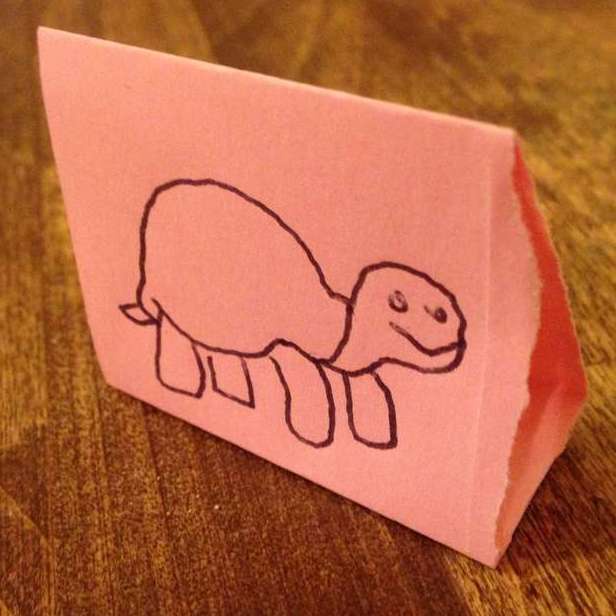
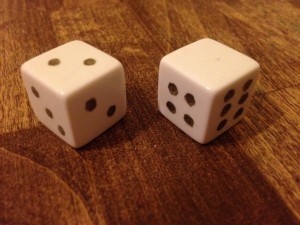
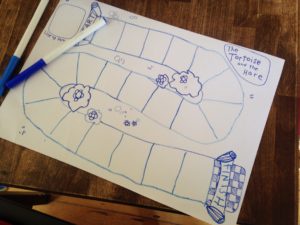
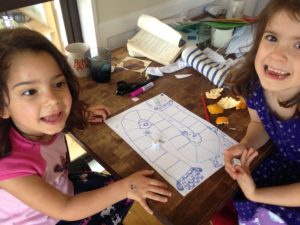
But it did get me wanting to design a game with my two daughters. So I pitched that we spend an afternoon or two doing exactly that, and they were game for it. Days before I had told them the story of the Tortoise and the Hare, and it seemed a good starting point: the race provided a linear A to B structure that would fit in with their other homework boardgame designs. So we chatted about how the tortoise moved, and how the hare moved. They liked rolling dice, so it seemed fitting to do that. I first showed them different types of dice, and how a d4 has a different movement than a d12. We tried a couple of tests with these, but it just meant the hare pretty much always won. Next I showed them some blank dice, and we decided to use those. Because you can draw on them.

We chatted about different die pip values and frequency, and how you can change the movement of a die. We went to AnyDice and saw some charts, which they enjoyed a lot more than I was expecting.

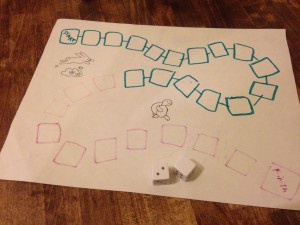
We ended up with a pretty good balance of numbers. The one thing was the blank sides for the Hare. We wanted to have the Hare stop along the way, and had tried using “must stop” locations on the board, but that seemed to have a predictability that wasn't desireable. The blank die sides are effectively a “miss a turn” roll, which is often bad game design, but it matched the metaphor so well we kept them. We did have to do more balancing later, but more on that later. The next step was the board. James Ernest has a great essay on volatility, including a section on the game “Kill the Elf”. In this game, the number of spaces in the race is effectively the hit points of the elf, and the tortoise the warrior and the hare the wizard. Too few spaces in the race, and the hare wins more frequently. Too many, and the tortoise has the advantage.

Board version 1 Board version 2 Playtesting

The girls were up for several rounds of playtesting. They definitely preferred to play the tortoise, but the hare won just as many games.

The game made it to school. The homeroom teacher took a look, and sent it back home with a note that there were “too many blank sides” to the hare die. It's always good to get external testing.

Checking out a book on interactive fiction.
#Games #Review

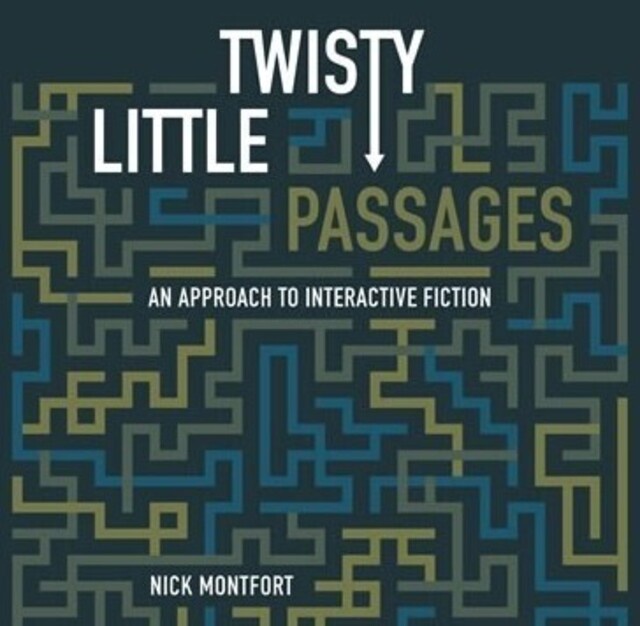
I grew up on choose-your-own adventures and Infocom text adventures. They're in my blood. So I'm a little predisposed to liking things that celebrate them. This is such a book. It's a pleasantly well-written history of the medium, along the way picking out specific examples of interactive fiction to highlight certain technological advances, cultural relevancies, or artistic developments. From a historical standpoint it leans heavily on prior work by Espen Aerseth, but this by no means devalues the work.

Montfort's initial argument is that interactive fiction shares much in common with the traditional riddle, and as such we can bring in traditional academic research on riddles to legitimize ludological studies:

The riddle, venerable ancestor of interactive fiction that it is, also goes a long way toward explaining how the literary and puzzling aspects of the form are hardly inherently antagonistic, but rather must work together for the effect of certain IF works to be achieved (Montfort, 63).

This book was inspiring to me on several levels. Firstly, in the academic rigor it displays in an emerging field of study, and the hopes I have for the same. Secondly, it made me desperately want to play those games again. From a purely practical standpoint, the incredibly well-researched bibliography is worth the admission alone.

I don't know, and that's great.
#Games #Review

This is a good book. It's short, but I also believe it could be shorter; it has some great information and is a worthwhile read. Costikyan's basic premise is that a essential feature of games is uncertainty, and that uncertainty originates from several locations: performative, solving, randomness, etc.

The book has seven chapters, but I see it as having three distinct sections: a general introduction to uncertainty and its sources, a lengthy analysis of many games using these sources, and a section on how designers can incorporate the idea of uncertainty to improve their games. While I grew tired of the lengthy analysis of games, it was in the applicability section that I felt the book really shines. My suspicion upon finishing the game is that Costikyan, an accomplished designer, has a very intuitive sense of games, and knows about manipulating uncertainty; that for this book he felt obliged to defend his own design experience with the analysis of classic and interesting games. Costikyan himself claims that looking at games through the lens of uncertainty is but one way to do so, and that such an approach is one tool in analysis and design:

Nor should you assume that uncertainty is the only important aspect of games, and that by understanding where uncertainty lies in a game, you understand it in an essential way, any more than, say, by understanding the role of plot in a novel, you understand everything worth understanding in it: subtext, the use of language, and the ways in which character is expressed are all of equal importance (Costikyan, 113).

Overall, this is a very worthwhile book for the demands it puts on the reader, and a very worthwhile addition to the study of games.

  • * *

Update: I just realized that Greg Costikyan was one of the original designers of the Paranoia RPG. That's bloody fantastic.

The Commons splash

A small game about ruining everything good
#Games #Original Games

During my Game Design and Play class, I'll often set an in-class assignment to design a game. These assignments come with restrictions, which I use to try to get my students to think about rules and elements in a different way. I also take up the challenge, and sometimes I get something I really like.

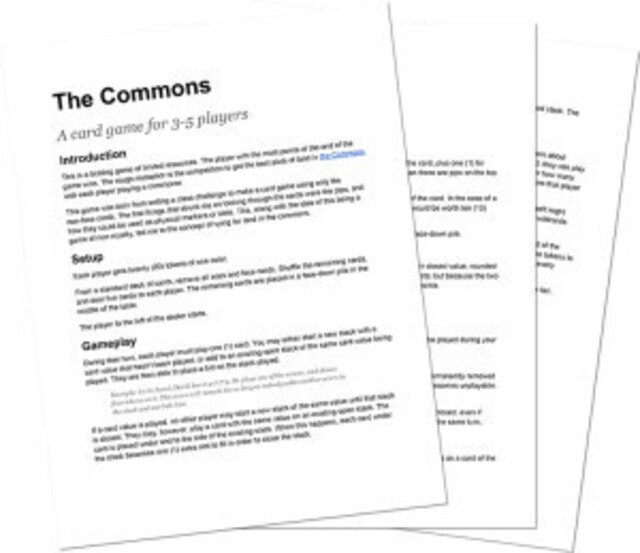
This last week the assignment was to make a game using a standard deck of cards, with the face cards removed. Here is what I came up with. I think it's pretty good.

The Commons Rules