Lucas Haley

review

Is your logic as strong as our logic?
#Card Games #Review

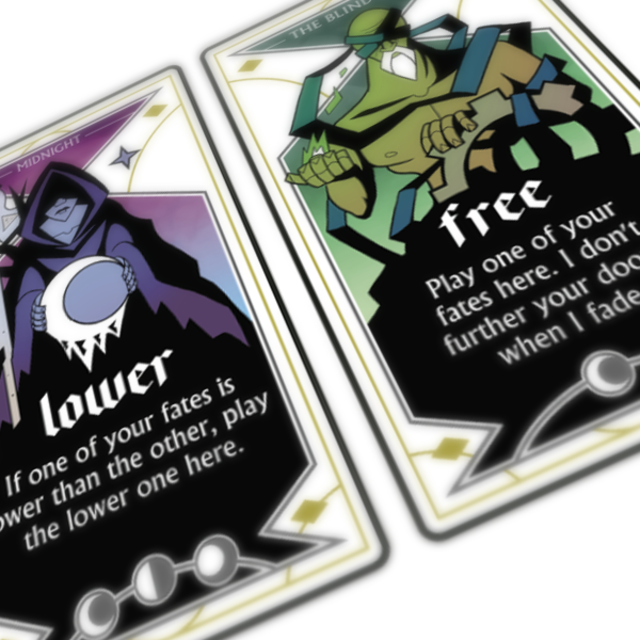
The Shipwreck Arcana is a card game of deduction and teamwork, from Meromorph Games. I picked up the print and play version of it while doing some research for next semester's game course, and sat on it for a while. I was initially taken by the artwork – a cool Mike Mignola-style take on pseudo-tarot cards – but the instructions weren't great.

It was only a week or so later that I read through the rules a couple of times, and got it. I know, I'm not the smartest.

It's a cooperative game, in which each individual player is trying to get the other players to guess the number of the chit in the their hand. Wrapped up in a pretty cool aesthetic.

I'm normally not a fan of cooperative games. I find they tend towards the one armchair leader – perhaps it's the particular coop games I've played, that just don't have the strategic options to actually have valid differing opinions on strategy. I'm also not saying that I'm the type of person who takes over a coop game – I tend towards not doing so. Sometimes to the detriment of my enjoyment of the game. Oh, and I also play clerics in D&D.
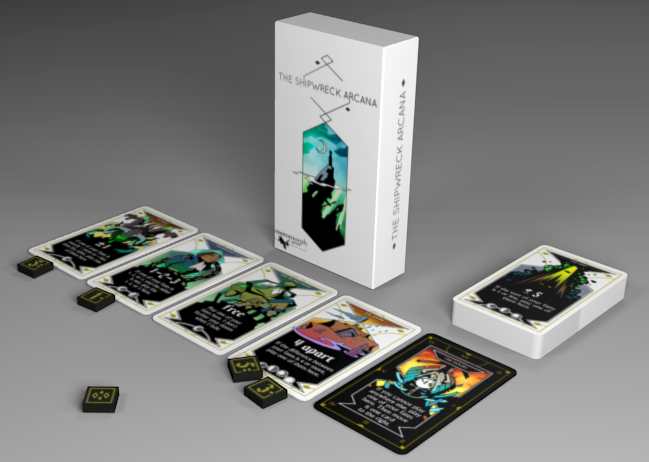
Anyways! The cool thing about the Shipwreck Arcana is that it's coop, but rotates ownership, so no one person can dominate. Each player takes a turn being the active player, in which they decide between two numbered chits to place onto one of four cards, each of which reveals some information about the placed chit. The other players then need to guess what the other chit's number is.

It's a bit like the bidding round of Bridge, in which the group are trying to use logic and knowledge of the active player to win the game. The active player tries to be as logical and informative as possible with one move, and the other players then try to deduce their move.

I have yet to try the game in a group – I ordered the physical version, and it'll take some time to arrive here in NZ. I'm eager to see how it plays!

Key Mechanics

Logic, cooperation, deduction, personality

Standout Mechanic

How one card has multiple uses through the Doom and Fade mechanics.
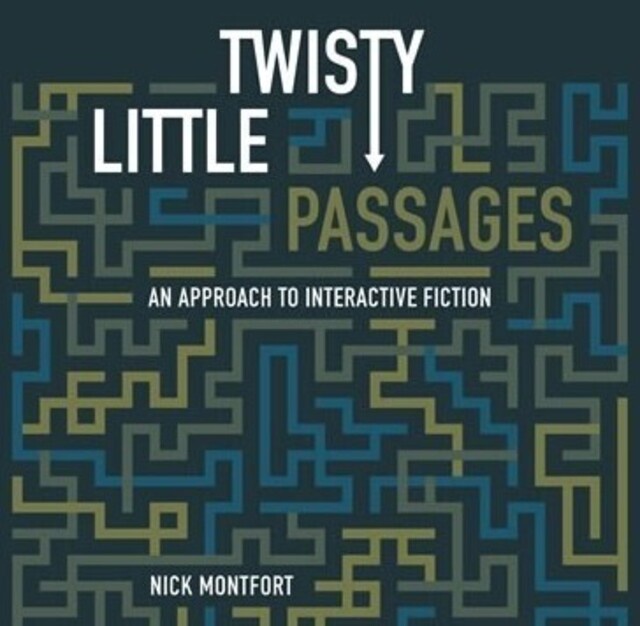
Checking out a book on interactive fiction.
#Games #Review

I grew up on choose-your-own adventures and Infocom text adventures. They're in my blood. So I'm a little predisposed to liking things that celebrate them. This is such a book. It's a pleasantly well-written history of the medium, along the way picking out specific examples of interactive fiction to highlight certain technological advances, cultural relevancies, or artistic developments. From a historical standpoint it leans heavily on prior work by Espen Aerseth, but this by no means devalues the work.

Montfort's initial argument is that interactive fiction shares much in common with the traditional riddle, and as such we can bring in traditional academic research on riddles to legitimize ludological studies:

The riddle, venerable ancestor of interactive fiction that it is, also goes a long way toward explaining how the literary and puzzling aspects of the form are hardly inherently antagonistic, but rather must work together for the effect of certain IF works to be achieved (Montfort, 63).

This book was inspiring to me on several levels. Firstly, in the academic rigor it displays in an emerging field of study, and the hopes I have for the same. Secondly, it made me desperately want to play those games again. From a purely practical standpoint, the incredibly well-researched bibliography is worth the admission alone.

I don't know, and that's great.
#Games #Review

This is a good book. It's short, but I also believe it could be shorter; it has some great information and is a worthwhile read. Costikyan's basic premise is that a essential feature of games is uncertainty, and that uncertainty originates from several locations: performative, solving, randomness, etc.

The book has seven chapters, but I see it as having three distinct sections: a general introduction to uncertainty and its sources, a lengthy analysis of many games using these sources, and a section on how designers can incorporate the idea of uncertainty to improve their games. While I grew tired of the lengthy analysis of games, it was in the applicability section that I felt the book really shines. My suspicion upon finishing the game is that Costikyan, an accomplished designer, has a very intuitive sense of games, and knows about manipulating uncertainty; that for this book he felt obliged to defend his own design experience with the analysis of classic and interesting games. Costikyan himself claims that looking at games through the lens of uncertainty is but one way to do so, and that such an approach is one tool in analysis and design:

Nor should you assume that uncertainty is the only important aspect of games, and that by understanding where uncertainty lies in a game, you understand it in an essential way, any more than, say, by understanding the role of plot in a novel, you understand everything worth understanding in it: subtext, the use of language, and the ways in which character is expressed are all of equal importance (Costikyan, 113).

Overall, this is a very worthwhile book for the demands it puts on the reader, and a very worthwhile addition to the study of games.

  • * *

Update: I just realized that Greg Costikyan was one of the original designers of the Paranoia RPG. That's bloody fantastic.